







Glass & glazing Blog
The Art of the Mirror: How to Choose the Perfect Glass Mirror for Your Home
The Art of the Mirror: How to Choose the Perfect Glass Mirror for Your Home
Few design elements transform a space as dramatically as a well-chosen mirror. Whether you are planning a sleek bathroom renovation, adding depth to a narrow hallway, or creating a bold decorative feature in your living room, the right mirror does far more than reflect your image — it shapes light, expands perceived space, and anchors the entire aesthetic of a room. For UK homeowners and designers looking to make the most of natural light and contemporary styling, bespoke glass mirrors have never been more accessible or more impressive.
Frameless Mirrors: Clean Lines for a Modern Interior
The frameless mirror has become the defining choice for contemporary UK interiors, and it is easy to understand why. Without a border to interrupt the eye, a frameless mirror appears almost weightless against the wall — a pure rectangle or custom shape of polished glass that blends seamlessly into its surroundings. This makes frameless mirrors UK homeowners favour a natural partner for minimalist décor, wet rooms, and open-plan living spaces where clean lines reign supreme.
Frameless designs are cut from toughened or standard float glass and finished with polished, bevelled, or pencil-ground edges, each giving a subtly different look. A bevelled edge catches the light and adds quiet glamour; a polished flat edge keeps things ultra-crisp. When specifying a bespoke frameless mirror, the choice of backing matters too — standard silver backing is the most affordable, while low-iron glass (sometimes called “Optiwhite”) eliminates the faint green tint found in conventional glass and delivers a crisper, truer reflection. For bathrooms, ensure any mirror is specified with moisture-resistant backing to prevent the black-edge deterioration known as “silvering.”
Bathroom Mirrors: Practicality Meets Style
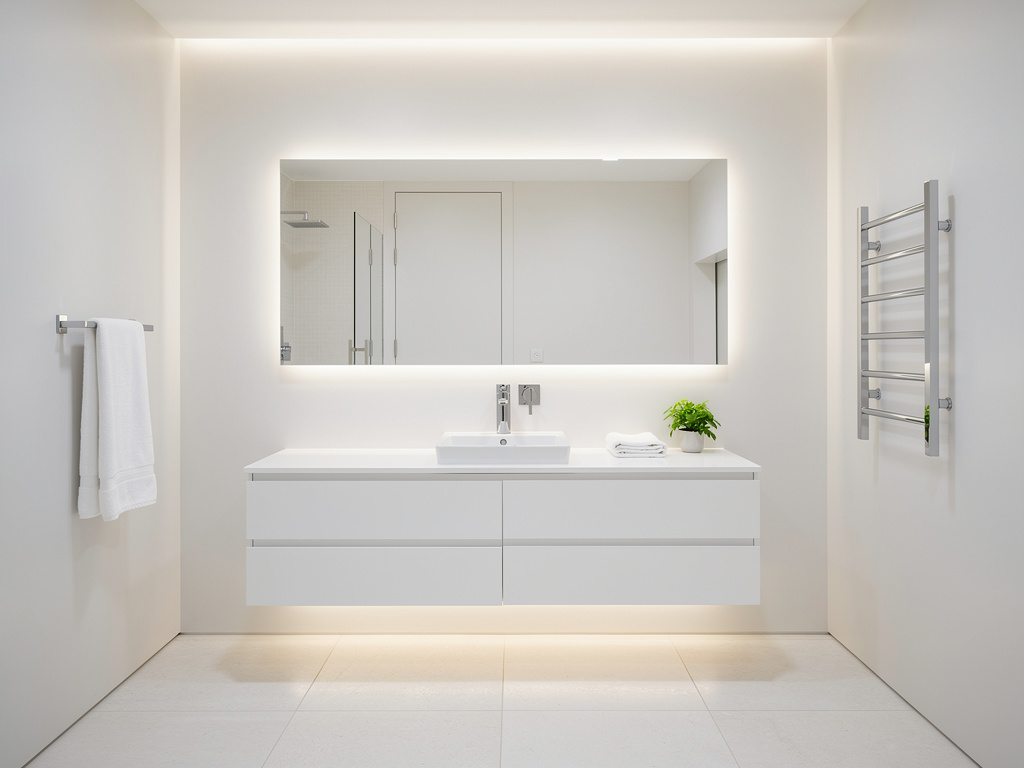
The bathroom mirror is often the most scrutinised piece of glass in the house, yet it is frequently treated as an afterthought. A bespoke bathroom mirror installation changes that completely. Rather than fitting a standard off-the-shelf unit, a made-to-measure mirror can span the full width of a vanity unit, wrap around a corner alcove, or be cut to follow the slope of an attic ceiling — options simply unavailable with retail products.
Illuminated bathroom mirrors have surged in popularity, with integrated LED strips along the top, bottom, or all four edges providing a warm or cool-white glow that is both functional and atmospheric. For those who prefer a cleaner look, surface-mounted spotlights or wall sconces positioned either side of the mirror at face height recreate the classic Hollywood dressing-room effect without a single wire visible on the glass itself.
Anti-fog heated pads bonded to the rear of the mirror are another worthwhile addition in any UK bathroom — no more wiping steam from the glass after every shower. These are low-wattage, thermostatically controlled, and straightforward for any electrician to connect during a bathroom fit-out.
Decorative Feature Mirrors: Making a Statement
Beyond the functional bathroom or hallway application, the decorative feature mirror has emerged as a major trend in residential and commercial interior design. A single oversized frameless panel above a fireplace, a full-height mirror leaning against a bedroom wall, or a bespoke shaped mirror in an irregular arch or hexagonal form — each creates a focal point that no artwork can quite match.
Decorative feature mirrors work particularly well in period properties, where they can be cut to echo the proportions of an existing chimney breast or alcove. In newer homes, large plain panels add drama without clutter. Antiqued or smoked mirror glass — glass that has been chemically treated to give a soft, aged patina — introduces warmth and character that bright modern mirrors lack, and pairs beautifully with brass or matte black hardware.
For retail, hospitality, and commercial spaces, mirror walls and large mirrored panels are a proven design tool for making compact rooms feel expansive. A series of floor-to-ceiling frameless mirror panels fitted edge-to-edge creates an almost seamless reflective surface. The technique is frequently used in restaurant design, boutique hotel lobbies, and fitness studios, but works equally well in a residential dining room or narrow urban kitchen.
Mirror Walls and Large-Format Installations
Mirror wall installations require careful planning, but the results can be extraordinary. The key considerations are the wall substrate (plasterboard, brick, and timber each need different fixings), the method of attachment, and the joint treatment between panels. Purpose-designed mirror adhesive, combined with discreet mirror screws or standoff fixings, creates a secure installation that will not pull away over time.
When specifying mirror wall glazing UK projects, always ask your glazier about the panel sizes available — standard float glass sheets max out at around 3,210 mm × 2,250 mm, but most domestic installations use smaller panels for practical handling. The joins between panels can be butt-jointed (gap-free), separated by a slim chrome or brass trim, or staggered in a brick pattern for a contemporary effect. Each approach gives a distinctly different finished look, so it is worth considering the overall design scheme before committing.
Safety is paramount in any large mirror installation. In areas where breakage risk is higher — gyms, children’s playrooms, busy hallways — toughened (tempered) glass is strongly recommended. Toughened mirror glass, when it does break, shatters into small blunt fragments rather than large dangerous shards, significantly reducing injury risk.
Choosing the Right Specialist
The quality of a mirror installation depends not just on the glass itself but on the skill and advice of the glazier you work with. Precise measurement, correct edge finishing, and proper adhesive selection all determine whether the finished mirror looks exactly as you envisioned — or becomes an expensive frustration. A specialist who works with bespoke glass day in and day out will guide you through the options, from glass type and thickness to edge profile and fixing method, ensuring the end result is both beautiful and built to last.
Whether you are planning a single bespoke bathroom mirror, a floor-to-ceiling mirror wall, or a series of custom decorative feature mirrors throughout your home, MyColourGlass offers expert advice and precision-cut glass to suit every project. Explore the full range of mirror glazing options at mycolourglass.co.uk and request a quote from a team that takes your vision seriously.